


Austria, like many European countries, is facing a growing shortage of skilled professionals. Demographic change and an aging workforce are shrinking the labour market, forcing companies to compete globally for qualified employees.
According to the ICMPD Migration Outlook 2026, labour shortages are already affecting business performance across Europe. Immigration is becoming the main contributor to sustaining Europe’s workforce. Governments can improve visa processes, qualification recognition, and migration frameworks. But the responsibility for integrating and retaining international talent lies with employers, and that requires far more than standard onboarding.
Why traditional onboarding is not enough?
Most international employees in Austria are onboarded exactly like local hires. International newcomers may speak the language and understand the instructions, yet they often struggle with the unwritten rules of workplace culture. Recent HR research confirms that international onboarding must go beyond traditional processes. A report by Stepstone Group from 2024 highlights that international professionals expect structured support not only during onboarding but already before they arrive in the country.
For many global professionals, relocation is a complex life transition. Moving countries involves not only a new job but also administrative procedures, housing, family relocation, and adapting to a new culture. Research aligns with Interconnected recent research and confirms that
successful onboarding of international employees requires more than standard HR processes.
A study by Stepstone highlights that international professionals expect structured support not only after they start their job but already before arriving in the country.
Nearly half of international professionals (46%) expect strong employer support during relocation and onboarding. This support typically includes assistance with housing, guidance through residence and work permit procedures, support for family relocation, and opportunities for language or cultural preparation before arrival. The study emphasizes that onboarding should begin before the first working day, making preboarding a critical stage in the international employee journey.
The research also shows that personal guidance plays an important role in successful integration. Around 40% of international professionals say they would benefit from having a mentor or buddy during their transition into a new organization and country. Some companies introduce buddy system in the onboarding phase, a colleague from a team that shows new colleague around, introduce him or her to other colleagues, but usually buddy doesn’t have time for more than that. Overall, the findings highlight that onboarding international employees is inherently more complex than onboarding local hires. In addition to professional orientation, companies often need to support immigration procedures, relocation logistics, cultural orientation, and integration into new professional and social networks. For this reason, structured preboarding and integration programs are becoming increasingly important for organizations that want to successfully attract and retain global talent.
This study aligns with Interconnected study where cultural trainings, personal support and language support are the common and needed forms of support in the relocation and integration process.
More about Interconnected study you can find in previous blog What makes settling in hard in Austria and How to improve the integration process for expats in companies.
More about Stepstone research you can read here in German:
https://www.stepstone.at/e-recruiting/hr-wissen/arbeitsmarkt/onboarding-internationale-fachkraefte/
What does this mean for companies?
These findings reinforce an important insight for organizations hiring global talent: successful international onboarding starts before the employee arrives and continues long after the first working day.
Companies that invest in structured preboarding, mentorship programs, and cultural integration initiatives are far more likely to:
- reduce early turnover
- accelerate team integration
- improve long-term retention of international professionals
In a labour market increasingly dependent on global talent, building these processes is a strategic advantage in the competition for international professionals.
This is why a structured process that combines preboarding, onboarding, and long-term integration is essential when welcoming international talent to Austria.”
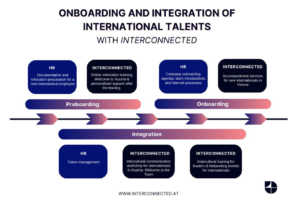
The onboarding and integration process for international talent in Austria includes three phases: preboarding, onboarding, and long-term integration support.
A structured approach: Preboarding, Onboarding, Integration
To support international talent effectively, organizations should think beyond traditional onboarding. A structured process includes three phases.
1. Preboarding
Integration begins before the employee arrives.
Preboarding may include:
- relocation andvadministrative guidance
- cultural orientation
- introduction to life in Austria
Providing cultural context and next steps helps international employees to prepare better and start their job with more clarity and less stress or culture shock. This way, you enable new employees to focus on performance instead of figuring out how the system works.
2. Onboarding
During onboarding, companies introduce internal processes, teams, and responsibilities.
For international employees, onboarding should also explain:
- business culture and workplace communication norms
- expectations of a team and management
- evaluation and feedback structures
- leadership and hierarchy styles
This helps new hires understand not only what to do, but how things work. Only when you know the rules can you act as a team player and communicate and collaborate effectively.
3. Integration
Integration is a long-term process that continues well beyond the first months.
Effective integration strategies may include:
- creating team culture
- training for leaders managing international teams
- networking opportunities for international employees to foster a sense of belonging
- support for relocating families
Benefits for HR and Organizations
- Protecting the hiring investment: International recruitment requires significant time and resources. Structured integration reduces the risk of early turnover.
- Reducing HR workload: Instead of handling repeated questions individually, organizations can provide structured orientation programs.
- Faster team integration: Employees who understand workplace norms collaborate more confidently and integrate faster.
- Improved retention: A supportive environment increases long-term employee loyalty and stability.
- Competing for global talent: Organizations that create welcoming environments gain a strong advantage in attracting global talent.
Final Thoughts
Filling the gaps and hiring international professionals is only the first step. The real challenge is creating workplaces where multicultural teams cooperate and communicate effectively and work together toward common goal.
Organizations that invest in both will be better positioned to compete for international talent.

Related Posts

How to improve the integration process for expats in companies
Hiring internationally is exciting. You’ve found the perfect candidate abroad.…


Inside the Expat experience: What makes settling in hard in Austria
Have you ever imagined what it’s like to leave behind everything familiar? Your…

Moving to Vienna: Your essential relocation checklist
Here is a general step-by-step relocation checklist with all the important…